


Johfra Bosschart, Unio Mystica, 1973
Johfra Bosschart and Occult Surrealism
Born Franciscus Johannes Gijsbertus van den Berg in Rotterdam in 1919, Johfra Bosschart became one of the most distinctive artists to combine surrealism with astrology, mythology, magic, witchcraft, religion, and occult symbolism.
The artist adopted the name Johfra from portions of his given names. Together with his wife, artist Ellen Lórien, he later lived and worked in France after leaving the Netherlands.
Johfra described his own work as surrealism informed by studies of psychology, religion, the Bible, astrology, antiquity, magic, witchcraft, mythology, and occultism. Those interests became the foundation of elaborate paintings filled with symbolic figures, strange landscapes, ritual imagery, animals, cosmic forms, and esoteric references.
Much of Johfra's early work was lost during the destruction of the Second World War, leaving his later paintings as the clearest record of the extraordinary visual world he developed.
Discovering Surrealism
During the German occupation of the Netherlands, Johfra had limited access to the international art world. One unlikely introduction to modern art came through a propaganda publication discussing so-called “degenerate art.”
Through reproductions he encountered artists including Salvador Dalí, Max Ernst, Yves Tanguy, and René Magritte. Dalí in particular became an important early influence, although Johfra would eventually develop a far more personal visual language rooted in esotericism and symbolism.
During the decades that followed, Johfra developed a flowing, organic form of surrealism and became associated with the Meta-Realist movement.

Witches' Sabbath I, 1977
Witches, Baphomet and Ritual Imagery
Johfra's largest compositions often present dense masses of figures within landscapes filled with occult and mythological symbolism. Rather than isolating a single magical symbol, he constructed entire worlds in which human beings, animals, spirits, architecture, and natural forms appear interconnected.
In Witches' Sabbath I, a Baphomet-like figure can be seen within a vast ritual landscape. The painting demonstrates how Johfra combined imagery associated with witchcraft and the occult with ideas about nature, transformation, and spiritual experience.

Interior of Unio Mystica, 1973
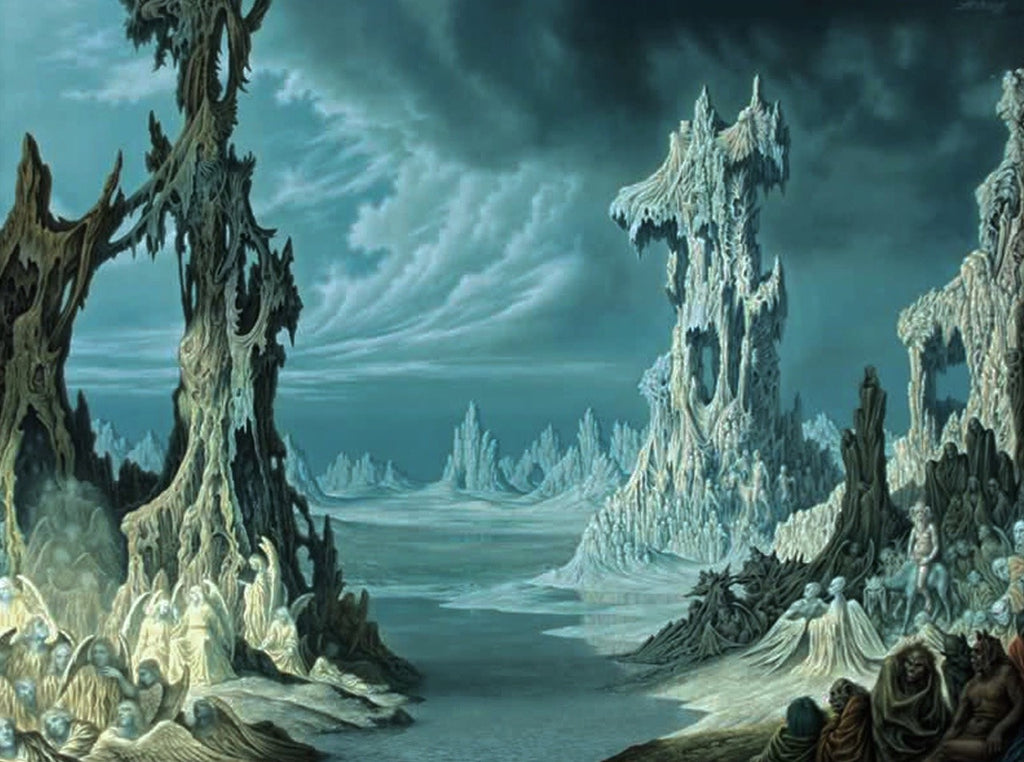
Children of the Moon, 1969

Children of the Moon, 1969, detail

El Sacrificio de Cannunas, 1979

Image via Monster Brains
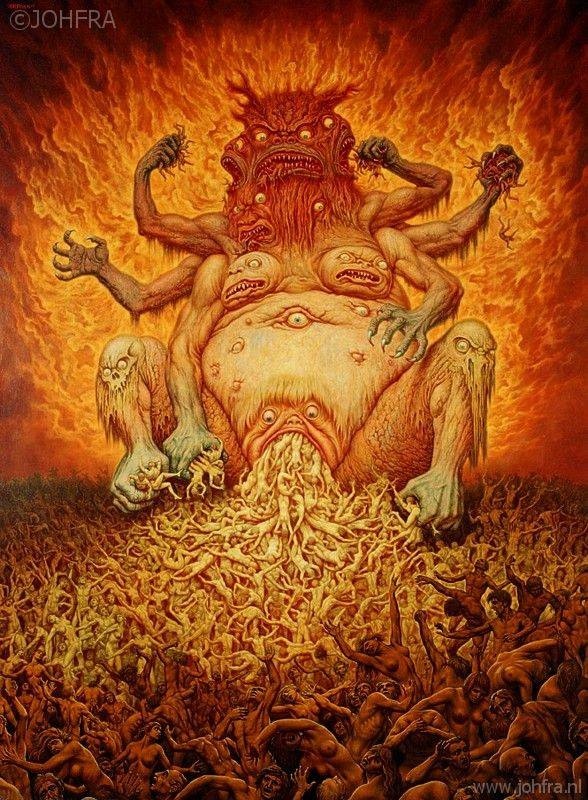
Kali, 1976
Paganism, Nature and the Occult
Johfra frequently used imagery associated with older pagan traditions, ceremonial symbolism, mythology, and the natural world. His paintings should not be reduced to simple images of Satanism or devil worship; the symbolism is considerably broader and often draws from multiple religious and mystical systems at once.
In works such as The Adoration of Pan, natural and mythological forces become part of an elaborate symbolic universe. Human figures merge with animals, plants, landscapes, and supernatural forms in scenes that suggest ritual, transformation, and the life force of nature.

The Adoration of Pan, 1979 (De aanbidding van Pan)
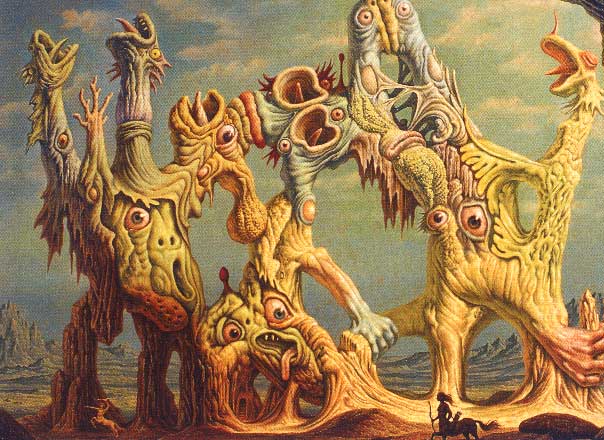
Nostalgia for Lemuria, 1961


Great Mother


The Journey Home

Pearl Guardian, 1971 (De behoeder van de parel)
Johfra's Zodiac Series
Among Johfra's best-known works is his Zodiac series, in which each astrological sign becomes the center of an elaborate symbolic composition.
Rather than simply illustrating the familiar zodiac figures, Johfra surrounded them with references to mythology, astrology, alchemy, religion, animals, sacred symbols, and esoteric traditions. The paintings operate almost like visual maps, rewarding close inspection as individual symbols begin to reveal relationships with one another.
The Zodiac paintings remain some of the clearest examples of Johfra's ability to combine traditional symbolism with the freedom and dream logic of surrealism.

Aquarius — Johfra Bosschart's Zodiac series
Why Johfra Bosschart Still Matters
Johfra occupies an unusual position between surrealism, visionary art, symbolism, and occult art. His paintings draw from centuries of esoteric imagery without functioning simply as illustrations of a single belief system.
Instead, mythology, astrology, magic, religion, psychology, and nature become raw material for vast imaginary worlds. That approach continues to resonate with contemporary dark artists working in surrealism, psychedelic art, tattoo culture, occult illustration, and visionary art.
Johfra Bosschart Art & Resources
Explore more of Johfra Bosschart's paintings, Zodiac imagery, surrealism, and occult symbolism through these selected resources.
- Johfra Bosschart on Monster Brains
- Johfra Bosschart — Visionary Revue
- Johfra Bosschart Archive on Facebook
- Johfra Bosschart on Visual Melt
- Johfra Bosschart's Zodiac Paintings
- The Grotesque & Twisted Surrealism of Johfra Bosschart
Johfra's strange synthesis of occult symbolism, mythology, astrology, and surrealism remains one of the most distinctive bodies of work in visionary dark art.
I want to buy the admiration of pan print. But I can’t find it, can I get a link?