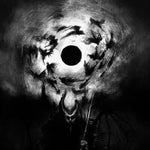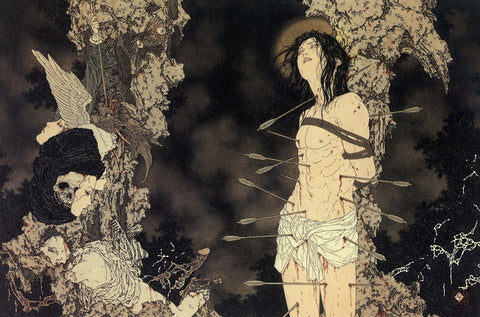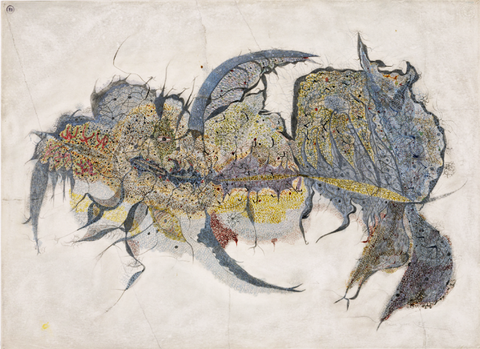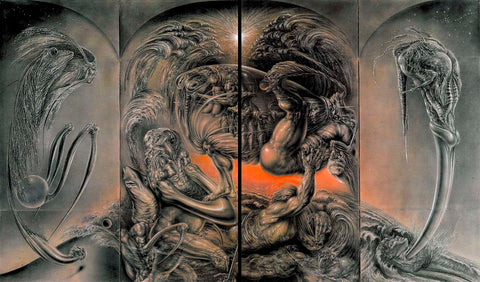
 Blood Fountains artwork by Stephen Kasner (Detail)
Tonight, Dark Art & Craft will be featuring the first of a three-part interview with the dark visual artist, musician and, photographer Stephen Kasner (April 3, 1970 – December 25, 2019). This in-depth interview with Thomas Haywood and Dott von Schneider takes a look into the inspiration and foundations of Kasner's dark creative work.
Read interview part I/III below:
Stephen Kasner
by Thomas Haywood and Dott von Schneider
What is your definition of creativity?
Stephen Kasner: Anything that attempts to be or become something greater than the sum of its parts. Creativity is an elevated result from the use of tools, visible or invisible.
What would you say was your initial inspiration to start creating art? When did you discover you had this natural ability?
SK: Just like most children, I always draw pictures. Drawing, concentrating on drawings, are among my earliest memories. I do recall my first vivid emotional connection to art which occurred at age 3. This was a completely random thing that evoked real emotion, actual fear, within me. This whole concept escaped me completely. I couldn’t possibly begin to wrap my mind around the reasons why I felt this fear, or how or why I could or would create something, seemingly unconsciously and from within myself that would produce these feelings. What use could I have for that at such a young age. It does prove, however, that fear, terror, uncertainty, are all feelings we naturally possess as human beings. They did come from somewhere. No one taught me that. Surely dark and terrifying emotions are instilled in all of us right from the moment of birth, perhaps even conception, but that’s an entirely different and more abstract concept.
Early on I would spend hours on end drawing in total solitude. Luckily for me, my parents didn’t think this strange and force me outside with other kids. That pursuit led me on all sorts of independent paths. Whenever I had an inspirational opportunity, I would draw from the television. I would watch old westerns and classic horror films and draw to them. More precisely, the movies would be on as a sort of soundtrack, and I would draw my own images to whatever scenarios I would hear occurring in the films. Later in life this was either an extension of, or perhaps simply a continuation of a natural method, when I began to really focus energy on translating musical artists works to imagery.
You’ve always been rather tied into the music scene, beginning locally. What is your personal history there?
SK: Among my childhood friends, I was always surprised to discover that I felt I was the most serious admirer of music, just from sheer appreciation, enthusiasm and emotional connection. I recall asking one of my friends in the fifth or sixth grade what his favorite music and musicians were, and he was completely perplexed. Confounded, even. He looked rather puzzled and asked, “You mean, like, radio?” I didn’t know how to respond to that, but having cited a few examples, the next bedazzling reply came, “I guess I like The Police. On the radio.” I had a lot of strange run-ins like that. But see, I thought everyone was like me. I just assumed it at the time. It was all I could do to join the orchestra to not go out of my mind. I did have the good fortune of having befriended an amazing drummer then who turned me onto foundation bands like The Beatles, Black Sabbath, Iron Maiden, very early on. This was a blessing because I personally had a limited access to records then, and he would let me borrow his. I would take the records home, and they would be like treasures to me. I would play them incessantly and draw from the album covers. It was heaven. Jeff is the first person I ever experienced a live, loud (drumming) session with, and he still plays, by the way. But this happening in front of me at that young age, in the same room where I can actually feel the pressure of the experience was mind-blowing.
So these experiences opened my mind to possibilities earlier on, and I began seeking the more extreme options, music and art, whatever I could access and digging into deeper sources. Within just a couple years, I was regularly locked in my room endlessly testing my mother’s seemingly limitless patience with Charged G.B.H., Dead Kennedys, Exploited, The Accused, Black Flag, MDC, Alien Sex Fiend, at maximum volumes at all hours. This absorption of punk music as well as the timing, then being 16 years old and now able to drive to any show I wanted to see, led me to a world where I was now in the same room with many of these amazing people, seeing them perform, changing lives on the spot. Small shows within my own neighborhood were bands like Domestic Crisis, Grimace, Starvation Army, Death of Samantha, and Spike In Vein, who were all massive influences on me. Once all these emotional floodgates were opened fully and for good, that was it for me. No turning back. 
Craw album artwork by Stephen Kasner, image via discogs.com/Craw-Craw/release/1171194
Your initial success in the industry came from working with bands and musicians. How did this come to be? Did you approach bands to work with them, or did they stumble upon you?
SK: A bit of both occurred. Naturally, early on I pursued musicians and bands I had access to locally. I was still in high school when I produced my first work for any band, which was probably The Spudmonsters, a still-legendary band connected to the punk/post-punk/metal scene of the ‘80s and '90s. Leading up to my initiation with Spudmonsters, I was seriously drawing and painting by then, though I didn’t have anything resembling a formed vision. Only fragments. So my first work with musicians came almost strictly under the heading of illustration, although most of the actual ideas were my own. Their Kill Your Idols record is a good example of this. I continued to dabble and connect with bands that needed assistance with imagery, producing everything from cassette covers, t-shirt graphics, hand painted backdrops. I was recently reminded that I did a backdrop for Spudmonsters. I’ll have to trust that lead. It’s probably right.
Chris Andrews was a founding member and guitarist for the band, and he owned the locally famous ‘Chris’ Warped Records’ store at the time. All the while I did any work for his band, money was usually never exchanged. I did album and T-shirt artworks in trade for records. I feel like I still do this type of literal trade-work a lot these days. Far too much, probably.
Things connected with music collaboration took a major turn during my college graduation exhibition when I was approached by Rockie Brockway of CRAW. In that show, I exhibited Dreamscape I & II simultaneously for the first time as these two works had only just been completed days before. Rockie was adamant about the fact that these were the pieces for the first CRAW album which was soon to be released. Being a major fan of the band and having seen them perform dozens of times by then, I knew them well, and agreed with the concepts. Of course I was more than pleased to contribute. Proud, really, and still am today. Those Dreamscape pieces were a major life shift for me and my work, and so was my connection with CRAW. That album was released in 1993. The next major Cleveland collaboration connection came a few years later when I met Dwid of Integrity. My work with Dwid became long-term and extensive, and grew to include actually recording and performing live together with Psywarfare. Most recently we collaborated again, also with Jacob Bannon of Converge, as Irons. So full circle, the collaboration system doesn’t break down or separate at just the imagery. I record and perform music with friends as well, and have for years.
Blood Fountains Artwork by Stephen Kasner 'Floods' Utech Records
In reference to your earlier statement, I would like to explore the concept of “translating musical artists work to imagery.” Can you expand on those experiences and how they transpire?
SK: These two elements have always been conjoined. I was always interested in drawing and painting, and became instantly wide-eyed realizing serious artist’s work in the world as a youth. Omni and Heavy Metal magazines in the late '70s and into the '80s, for example, initiated me into the world of Fantastic and Visionary artists such as Ernst Fuchs, Beksinski, H.R. Giger, Robert Venosa, and many others, and I would absorb these images while listening to records. This was my hobby, really, outside of actually drawing myself. I was equally, deeply connected to music of that era; Psychedelic and hard rock, '70s metal, and I began to study guitar from age 8 with instructors as a by-product of this insatiable passion. Ironically, I wasn’t learning what I wanted to play, you know, Led Zeppelin riffs, but was being taught classical and Spanish music. I thought this was a drag at such an early age, and my mind couldn’t connect to the magical road I was being led on then. I couldn’t realize I was being given the keys to the gate. But I continued studying formally for seven years or so, at which point the drawing and painting medium eclipsed everything completely. I still have the musical passion today to create and produce my own sounds, but now it’s very stream of consciousness, improvisational, transient. There’s little structure, but for reasons.
I always knew innately that art and music were one entity, and so this marriage of sound and image was always a deeply connected essence within, so I subconsciously fused the two, always. Once I realized, perhaps closer to my teen years, that real artists in the world did precisely this type of work, on some of my favorite record album covers for example, that was it for me. This was the silver lining; that I could find some way to connect these mediums seriously, as a lifelong pursuit, and I’ve never flinched from these methods and modes of thinking. It’s a spiritual existence, if you are one who can take it that way. It is religious for many people I know.

Pale Creation, Twilight Haunt album art by Stephen Kasner, image via Discogs
You work is so ethereal and so unique, it is hard to find a parallel with any other artist outside of the late, great H.R. Giger. Do you find a parallel or influence with and from his work?
SK: I would think it difficult not to. I recognize his immense popularity now, but this wasn’t always the case, and to me, that’s part of what makes his work so much more magical. What I mean is, growing up in the '70s, being a child and inadvertently stumbling onto paintings by Giger through OMNI or on album covers like ELP’s Brain Salad Surgery, for example, this work burns into your brain, particularly if you’re a type of person predisposed to his kind of majestic, psychedelic expressionism. If you have even half a spirit, Giger’s work remains with you for a lifetime, and I spent my early years searching it out. It became utterly, thoroughly surreal later meeting and spending time with him in his home and studio in Switzerland. Oddly, even as a young teen, he was one of only two living people who I ever dreamed of meeting. Never obviously expecting either of these events to become a reality, I’m proud to say I’ve met and bonded with both my deepest heroes. These were major, life-altering events, naturally, which have affected the way I see and think, thank goodness.
H.R. Giger, Emerson Lake & Palmer's Masterpiece Album Brain Salad Surgery image via Wikipedia
There is a strong representation of heavy writers, artists, and musicians narrating your book, Stephen Kasner, WORKS: 1993-2006. How did you connect with these folks? How did the book first come about?
SK: I’ve been extremely fortunate to have met so many amazing, magical artists and people worldwide. In traveling and exhibiting my work in other environments, it becomes rather natural to gravitate to other artists you admire and gain access to, and for them to gravitate to you. These are all people who share a similar energy, focus, and outlook on things, so the will to work together is also natural. I think the sheer curiosity of what may come of joining with another person or people is utterly compelling. It’s like love. We all want to give and receive as much love as we possibly can in all its available forms. At least we all should want that.
What’s the best thing about Halloween?
SK: Dreaming the dream that somewhere in the world exists a most intrepid and ever-potent witch. But then every day is Halloween, isn’t it?
Please follow Dark Art & Craft for part two: XABRACADABRA The Magical Art of Stephen Kasner Part II/III
View some of Stephen Kasner limited edition print work on Dark Art & Craft, available this Halloween night Tuesday, Oct. 31, 2017...