

The Darker Side of the Renaissance
The Renaissance is often remembered for idealized beauty, classical proportion, and renewed interest in the ancient world. But many of its artists were equally fascinated by death, judgment, violence, martyrdom, witchcraft, demons, and the instability of human life.
Across Northern Europe and Italy, painters transformed religious stories, visions of Hell, biblical violence, classical myth, and scenes of mortality into some of the most psychologically intense images in Western art.
This article explores several masters who pushed those darker subjects into unforgettable visual territory, from Hieronymus Bosch and Pieter Huys to Caravaggio, Salvator Rosa, Artemisia Gentileschi, and Pieter Bruegel the Elder.

Jan van Eyck, The Last Judgment, detail from the lower section of the diptych, c. 1440–1441. Image via Wikimedia Commons .
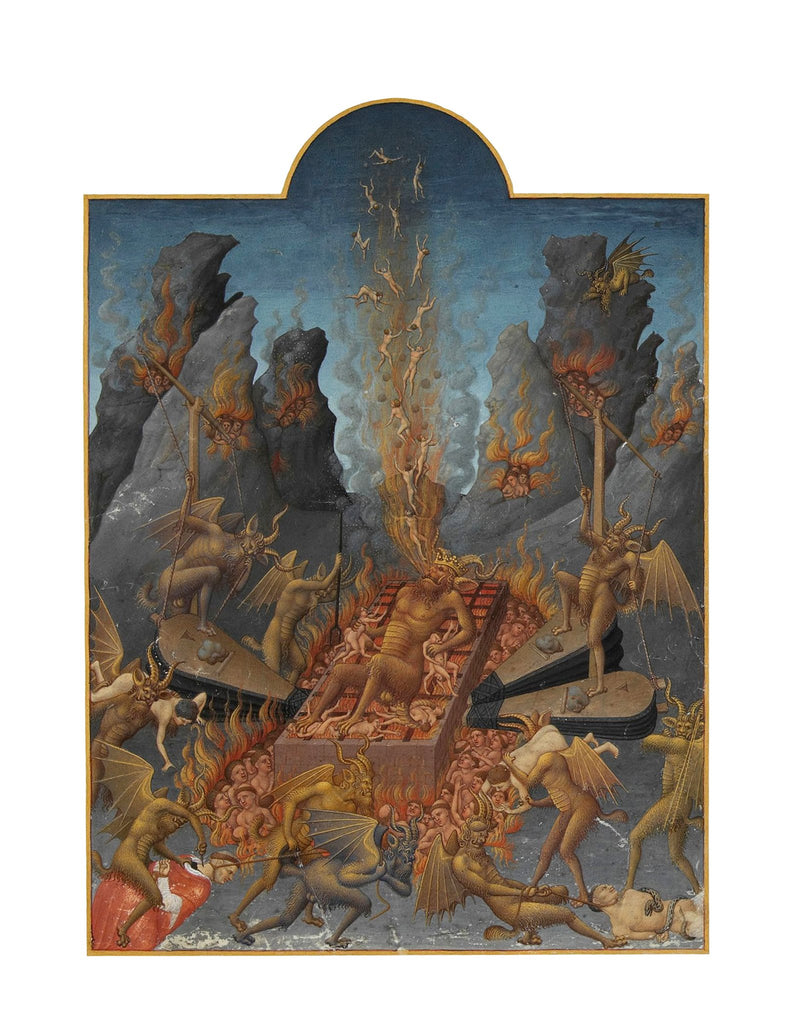
Lucifer Torturing Souls as well as Being Tortured Himself in Hell, from Les Très Riches Heures du duc de Berry, by the Limbourg Brothers. Created in the early fifteenth century, the scene presents Hell as a crowded, theatrical vision of punishment, fire, monsters, and suffering. View the Dark Art & Craft framed reproduction.
Hieronymus Bosch
Hieronymus Bosch was an Early Netherlandish painter whose work remains among the strangest and most unsettling of the late medieval and early Renaissance world. His paintings are filled with hybrid creatures, grotesque bodies, demons, strange machines, religious symbolism, and vast imagined landscapes.
Bosch’s visions of temptation, sin, punishment, and Hell feel almost surreal to modern viewers. His compositions often place hundreds of tiny figures into chaotic scenes where human bodies merge with animals, architecture, musical instruments, and monstrous forms.

The Garden of Earthly Delights, attributed to Hieronymus Bosch, c. 1490–1510, Museo del Prado, Madrid. Image via Wikipedia .

The Temptation of Saint Anthony, attributed to Hieronymus Bosch. Image information via the Netherlands Institute for Art History .
Pieter Huys
Pieter Huys was a Flemish Renaissance painter active in Antwerp and one of several artists strongly influenced by the fantastical visual world associated with Bosch.
His paintings are crowded with demons, hybrid creatures, grotesque figures, and complex infernal landscapes. Rather than treating Hell as a distant theological idea, Huys filled his compositions with dozens of small scenes of danger, punishment, temptation, and monstrous transformation.

The Inferno, Pieter Huys, 1570. Image via Wikimedia Commons .

The Temptation of Saint Anthony , attributed to Pieter Huys, oil on oak. View the Dark Art & Craft reproduction.
Dark Renaissance and Baroque Painting
As Renaissance and Baroque art developed across Europe, artists increasingly explored dramatic lighting, physical violence, intense emotion, mortality, and psychologically charged religious scenes.
Painters such as Caravaggio used chiaroscuro — strong contrasts between light and darkness — to make biblical and historical events feel immediate and theatrical. Heads emerge from black backgrounds, bodies are caught at the moment of violence, and sacred narratives become intensely human.

Caravaggio, Judith Beheading Holofernes. Image via Wikimedia Commons .

Caravaggio, The Crucifixion of Saint Peter, c. 1600. The painting is a powerful example of dramatic light and shadow used to heighten the physical weight of the scene. Image via Wikipedia .

Magdalene with the Smoking Flame, Georges de La Tour, c. 1640. The skull functions as a memento mori, a reminder of mortality and the transience of life.
Salvator Rosa
Salvator Rosa developed a reputation for unconventional subjects, dramatic landscapes, and dark scenes that stood apart from the polished classicism of many of his contemporaries.
His interest in witchcraft, magic, grotesque figures, and nocturnal ritual produced some of the most striking occult imagery of seventeenth-century painting. Works such as Witches at Their Incantations combine theatrical darkness with strange ritual objects, bodies, animals, and supernatural suggestion.

Witches at Their Incantations, Salvator Rosa, c. 1646. © The National Gallery, London.

Witches at Their Incantations, lower-left detail. Image via Pinterest .
Rosa’s work helped establish a visual language in which witchcraft, divination, supernatural fear, and grotesque imagery could become serious subjects for ambitious painting rather than merely decorative curiosities.
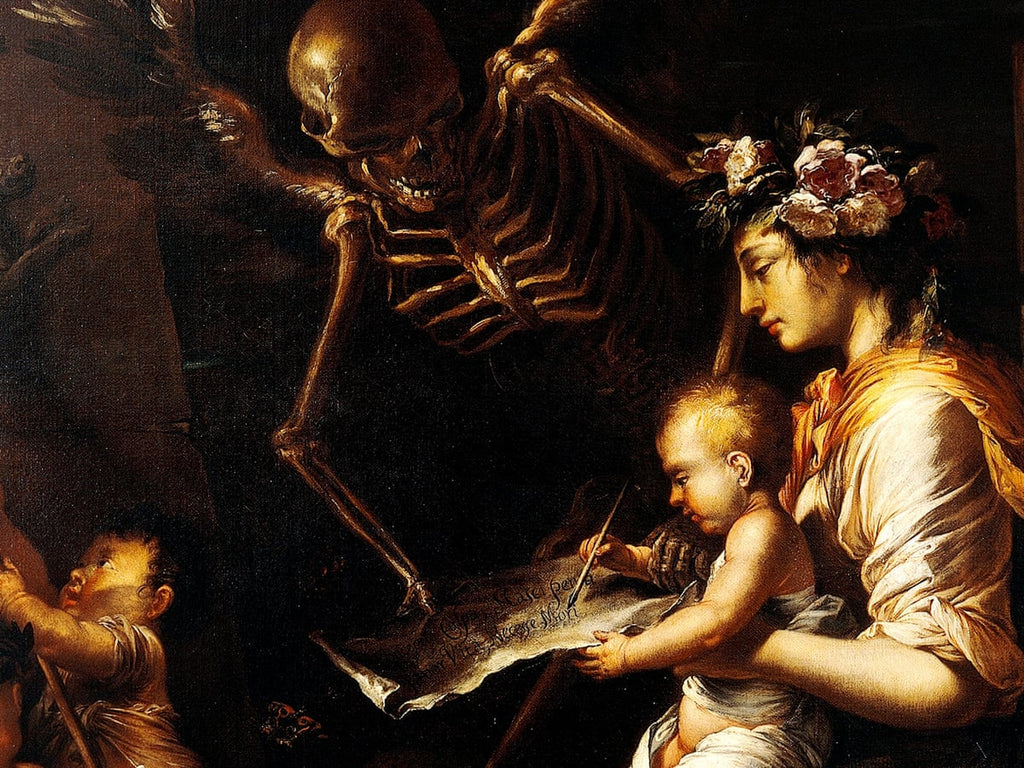
Detail from Salvator Rosa's Human Frailty (1656). Image via Reddit .

Witches at Their Incantations, Salvator Rosa, c. 1646, detail.
Artemisia Gentileschi
Artemisia Gentileschi was an Italian Baroque painter whose work combines dramatic lighting, physical force, biblical narratives, mythology, and some of the most intense depictions of violence produced in seventeenth-century art.
She was strongly influenced by Caravaggio, but developed a distinctive visual language of her own. Her figures often feel physically present and emotionally committed to the action, giving familiar biblical stories unusual psychological force.

Judith Beheading Holofernes , Artemisia Gentileschi, c. 1620. This version is one of the most visceral interpretations of the biblical scene, emphasizing physical struggle, blood, and determination.
The Northern Renaissance and the Art of Death
Northern European artists developed their own dark visual traditions around death, religious judgment, war, social instability, and the fragility of life. Detailed landscapes could contain scenes of mass destruction, armies, skeletons, monstrous architecture, and entire worlds apparently collapsing under violence.
Pieter Bruegel the Elder is one of the strongest examples. His paintings combine panoramic observation with allegory, folklore, violence, and an often bleak view of human behavior.

The Triumph of Death, Pieter Bruegel the Elder. Image via Wikimedia Commons . View the Dark Art & Craft reproduction.

Dulle Griet, Pieter Bruegel the Elder, depicting a chaotic landscape filled with armed women, grotesque creatures, and an anthropomorphic Mouth of Hell.

The Crucifixion; The Last Judgment , Jan van Eyck and workshop assistant. The lower-right section presents a dense vision of Hell filled with bodies, punishment, and monstrous forms.
Why Dark Renaissance Art Still Feels Modern
These artists were not creating “dark art” as a modern genre. Their work emerged from religious belief, social upheaval, mortality, mythology, patronage, and the visual traditions of their own time.
Yet many of the images still feel startlingly contemporary. Bosch’s impossible creatures resemble surrealism. Caravaggio’s lighting feels cinematic. Rosa’s witches anticipate later occult imagery. Gentileschi’s violence remains psychologically immediate. Bruegel’s skeleton-filled landscapes still read as visions of apocalypse.
That combination of beauty, horror, symbolism, and human vulnerability is why the darker Old Masters continue to resonate with artists, collectors, and anyone drawn to macabre visual culture.
Dark Renaissance Art & Old Master Resources
Explore more about the artists, paintings, hellscapes, and darker traditions of Renaissance and Baroque art.
- Dark Art & Craft Old Master Reproduction Prints
- Dark Ages & Renaissance Paintings
- Caravaggio: A Life of Art and Violence
- Nightmarish Depictions of Hell in Art History
From infernal landscapes and martyrdom to witchcraft and memento mori, the darker side of the Old Masters remains one of the richest sources of imagery in Western art.
love it. can really feel the drought in these paintings