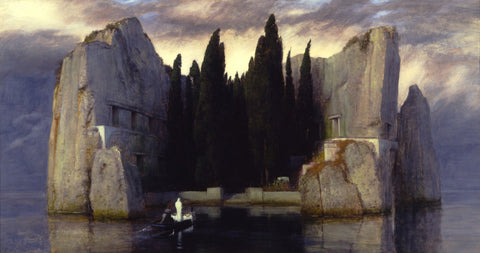
 Intermezzo, from the series A Love, Opus X, no. 6 (1887), etching with engraving and aquatint, 19.1 x 42 cm, Museum of Fine Arts, Houston
Max Klinger understood that some images belong to daylight and others belong somewhere much darker.
The German artist, born in Leipzig in 1857, worked as a painter and sculptor, but it was in printmaking that his imagination became truly strange. Across elaborate cycles of etchings, engravings, aquatints and mezzotints, Klinger constructed private worlds filled with desire, anxiety, erotic obsession, death, myth and dream.
His pictures often begin in recognizable reality before slipping quietly into nightmare.
A glove becomes an object of obsession. Death enters ordinary life without warning. Sea monsters emerge from fantasy. Bodies are threatened, worshipped or transformed. Mythological figures appear beside contemporary men and women as if the ancient world has broken through the surface of modern Europe.
Klinger did not simply illustrate dark subjects. He understood that black-and-white printmaking itself could become a language for the unconscious.

Max Klinger (1857–1920), German Symbolist painter, sculptor, printmaker, and etcher.
Awakening, from the series A Love, 1887–1903.
Etching and engraving, 55.4 × 40.9 cm (21¾ × 16 in).
Collection of the Metropolitan Museum of Art, New York, United States.
Artist information and image source: Art Renewal Center.
The Dark Side of the Image
Klinger had unusually ambitious ideas about graphic art.
In his 1891 theoretical text Malerei und Zeichnung (Painting and Drawing), he argued for a distinction between painting and graphic work. Painting, in his view, was particularly suited to the visible world, while printmaking could travel into regions of imagination, conflict and psychological darkness.
The British Museum summarizes Klinger's position especially well: he believed prints could address the darker side of existence and produce associations in the viewer similar to those created by poetry or music.
That idea runs through almost everything important in his graphic work.
Klinger's prints rarely feel like isolated illustrations. He arranged them into sequences he called Opus cycles, creating visual narratives that unfold almost like silent films, dreams or pieces of music.
The Metropolitan Museum of Art notes that Klinger ultimately produced fourteen major print cycles between 1879 and 1915. Their strange combinations of fantasy and everyday reality would later make him appear remarkably close to Surrealism decades before Surrealism formally existed.

Max Klinger (1857–1920), German Symbolist painter, sculptor, printmaker, and etcher.
Krieg, from the series Vom Tode, Zweiter Teil.
Etching, 55.8 × 40.1 cm (21¾ × 15¾ in).
Collection of the Metropolitan Museum of Art, New York, United States.
Artist information and image source: Art Renewal Center.
Desire Becomes a Nightmare
The darkness in Klinger is rarely Gothic in the obvious sense. There are no endless ruined castles or theatrical armies of demons. His horror is usually psychological.
A respectable nineteenth-century environment suddenly becomes unstable because someone desires something too intensely. Ordinary objects acquire impossible importance. Fantasy expands until reality can no longer contain it.

Max Klinger, A Legation, 1882. Oil on panel, 37 × 63 cm. Museum der bildenden Künste, Leipzig, Germany. Source: Wikipedia.
That is what makes A Glove so unsettling. The glove itself is harmless. The mind surrounding it is not.

Abduction Public domain Wikipedia
Klinger repeatedly returns to this tension between civilization and whatever is hiding underneath it: sexuality, jealousy, violence, loneliness, fantasy and death.
His polished technique only makes the disturbance stronger. These are not frantic drawings made without control. Many of the prints are extraordinarily precise.
Dreams are rendered with the authority of documentary evidence.
Death Arrives Without Permission
Klinger returned obsessively to death.
In Vom Tode, Erster Teil — On Death, Part One, Opus XI — completed in 1889, death enters human life suddenly and almost casually.
The Cleveland Museum of Art describes the ten-print sequence as an exploration of life's fragility and the abrupt arrival of death. A contemporary critic compared the portfolio to a modern Dance of Death.

Max Klinger (1857–1920), Am Meer, from Intermezzi. Etching, 38.9 × 56.4 cm (15¼ × 22 in). Metropolitan Museum of Art, New York. Source: Art Renewal Center.
That comparison is appropriate. Medieval and Renaissance Danse Macabre imagery reminded viewers that death eventually collects everyone regardless of class or wealth.
Klinger modernized the idea. His victims occupy a recognizable nineteenth-century world. Death is no longer safely contained within medieval allegory. It has entered modern life. The result is less theatrical than much traditional memento mori imagery and perhaps more disturbing because of it.
Death simply appears.

On Death, Part I, 1889. Max Klinger (German, 1857–1920). Etching and aquatint. The Cleveland Museum of Art, Gift of The Print Club of Cleveland, 1933.126
The Graphic Cycle
One of Klinger's greatest contributions to dark art was not a particular monster, corpse or symbol.
It was the idea of the graphic cycle itself. Rather than treating prints as individual works, Klinger organized them into visual suites capable of developing themes across multiple images.
An image could introduce an idea. Another could contradict it. Another could transform it into fantasy. Another could return suddenly to reality. This gave printmaking something close to musical structure. The approach would become enormously influential.
Klinger's mixture of psychological darkness, narrative ambiguity and graphic sequencing was admired by later artists associated with Expressionism and Surrealism. The Met specifically notes that both movements found important precedents in his exploration of the uncanny and in his use of the print cycle.
It is difficult to look at some twentieth-century graphic art without sensing Klinger somewhere behind it.

Max Klinger (1857–1920), Back into Nothingness, plate 15 from A Life, 1884. Aquatint and etching. Art Institute of Chicago. Source: Art Renewal Center.
Brahms Fantasies
Music offered Klinger another path into images that did not need to obey ordinary narrative. His monumental Brahms-Phantasie, Opus XII, published in 1894, combined graphic imagery with compositions associated with Johannes Brahms.
Klinger deeply admired Brahms, and the project became something more ambitious than conventional musical illustration. Images move around musical notation. Mythological forms emerge. Dream landscapes appear. Figures struggle, mourn and drift through symbolic worlds.
The New York Public Library describes the work as a combination of graphic images and musical scores that creates a series of visual “fantasies.” Works within the cycle carry titles such as Night, Sacrifice, Titans and Evocation. Even without hearing the music, the images seem to operate rhythmically. Forms emerge from darkness and disappear again. Some pages feel less like illustrations than visions produced by listening.
Between Symbolism and Surrealism
Klinger can be difficult to place neatly within one movement.
Much of his work belongs naturally beside Symbolism, with its fascination with dreams, myth, sexuality, death and interior experience. The National Galleries of Scotland similarly describes him as difficult to classify while noting that much of his work can be considered Symbolist.
But some Klinger prints look astonishingly prophetic. Impossible transformations occur without explanation. Objects become emotionally charged. Scale becomes unstable. Erotic obsession produces visual hallucination. The everyday world opens unexpectedly into another reality. It is not difficult to understand why later Surrealists admired him.
Klinger had already discovered that one of the most disturbing things an artist can do is render an impossible event with absolute technical seriousness.
Max Klinger's Dark Art
Klinger died in 1920, just as European art was entering another radically different period. Expressionism had already appeared. Dada was underway. Surrealism would officially emerge only a few years later. Yet much of the psychological territory those artists explored had already appeared in Klinger's prints.
Dreams without explanations. Eroticism displaced onto strange objects. Violent transformations. Myth entering modern life. Death appearing inside ordinary reality.

Max Klinger (1857–1920), Going Under, from A Life, 1884. Etching and aquatint. Metropolitan Museum of Art, New York. Source: Art Renewal Center.
Most importantly, Klinger recognized that darkness did not require a supernatural monster. Sometimes a glove is enough. Give an ordinary object sufficient desire, fear and imagination, and eventually it becomes something else. That may be Klinger's most modern quality. His nightmares do not always come from outside. They are produced by the mind looking at the world.

Max Klinger (1857–1920), Dritte Zukunft, from Eva und die Zukunft, 1898. Etching. Metropolitan Museum of Art, New York. Source: Art Renewal Center.
Resources & Further Looking
The Metropolitan Museum of Art — The Graphic Art of Max Klinger
An excellent introduction to Klinger's printmaking, graphic cycles, techniques and influence on later Expressionist and Surrealist artists.
The Metropolitan Museum of Art — Max Klinger Collection
The Met holds numerous prints from A Glove, Brahms Fantasies and other series, with high-resolution images and individual object records.
Museum of Modern Art — A Glove, Opus VI
MoMA's collection contains the complete sequence and individual records for several plates. It is one of the easiest places to explore Klinger's most famous narrative cycle image by image.
Cleveland Museum of Art — On Death, Part One, Opus XI
The museum holds the complete ten-print series, an essential work for understanding Klinger's treatment of mortality and the modern Dance of Death.
National Gallery of Art — Max Klinger
The NGA collection includes works from A Glove, Brahms Fantasies and other graphic projects, with downloadable collection information and artwork records.
National Museum of Western Art — Max Klinger's Prints: Dream Sequences Drawn from the Stylus
Useful background on Klinger's print cycles and the importance of graphic art within his larger career.
Wesleyan University — Max Klinger and Johannes Brahms: An Artistic Convergence
A digital research project devoted specifically to the Brahms-Phantasie, useful for examining how Klinger combined music, poetry and visual art.
British Museum — Max Klinger
Particularly useful for Klinger's theoretical ideas concerning painting, drawing and printmaking, including his belief that graphic art could explore the darker and more associative regions of experience.