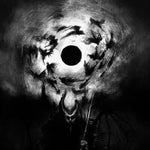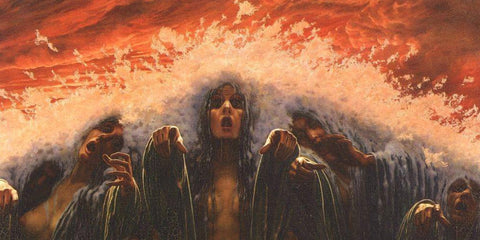

Hyman Bloom, Skeleton (1936). Photo courtesy of the Lane Collection and the Museum of Fine Arts, Boston, ©Stella Bloom Trust.
Hyman Bloom painted death as if there were still something alive inside of it.
Cadavers split open on autopsy tables, exposed organs, severed limbs and decomposing bodies appear throughout some of his most powerful paintings. But Bloom was not interested in simple horror. His corpses glow with reds, yellows, violets and strange pearly even beautiful colors. Thick paint turns ruined flesh into something almost jewel-like and vibrant.
The result is difficult to look at and equally difficult to look away from.

Hyman Bloom, Self-Portrait, oil on canvas, 53 x 35 in., 1948,
Hyman Bloom
Born in 1913 in what is now Latvia, Bloom immigrated with his family to Boston as a child in 1920. He began studying art while still young and eventually became an important figure in the Boston art world, developing a highly personal form of expressionist painting far removed from the cleaner abstraction gaining attention in New York.
By 1942, thirteen of his paintings were included in the Museum of Modern Art exhibition Americans 1942: 18 Artists from 9 States. MoMA purchased two of them. Bloom was not yet thirty.
His subjects ranged from rabbis and synagogue interiors to forests and mystical imagery, but it is his paintings of corpses and autopsies that remain among his darkest and most unsettling works.

Hyman Bloom, Female Corpse, Back View (1947) image via https://news.artnet.com/art-world/hyman-bloom-mfa-boston-1616383
Inside the Body
Bloom's interest in cadavers began during the 1940s after visiting a morgue. Instead of turning away from decomposition, he studied it.
Paintings such as Corpse of an Elderly Male, Female Corpse and later works connected to autopsy and anatomical dissection place the dead body directly before the viewer. There is very little distance between observation and decay.

Hyman Bloom’s “Female Corpse, Front View.” 1945. (Courtesy of Courtesy Stella Bloom Trust/Museum of Fine Arts, Boston)
Yet Bloom's treatment of flesh is strangely beautiful.
The body becomes an environment of color. Skin breaks into green, violet, yellow and red. Internal organs emerge from darkness through heavy passages of paint. Forms that should produce disgust sometimes begin to resemble flowers, minerals or wet pieces of fabric.
For Bloom, decomposition was not simply an ending. The physical destruction of the body could suggest transformation—the point where one form of existence begins disappearing into another. The Museum of Fine Arts, Boston describes his work from this period as an attempt to bring the physical and spiritual together on canvas.

Slaughtered Animal (1953), oil on canvas, 70 x 40in.
Beauty Where It Shouldn't Be
This is what makes Bloom's darker paintings so unusual.
He does not make death clean or symbolic. The corpse remains a corpse. Flesh opens. Organs spill outward. The anatomy is recognizable enough to make the viewer uncomfortable.
But color refuses to let the image become purely clinical.
Bloom found visual richness inside decomposition itself. The morgue offered colors and surfaces that painting could transform without hiding what they actually belonged to.
There is something almost forbidden about that attention.
The viewer is placed in the same uncomfortable position as the artist: repelled by the dead body while still examining its colors, textures and forms.

Hyman Bloom, The Anatomist (1953). Image via https://news.artnet.com/art-world/hyman-bloom-mfa-boston-1616383
Death as Transformation
Bloom's paintings belong to Dark Art not simply because they contain corpses, but because they refuse the easy separation between beauty and death.
A dissected body can be horrifying and luminous at the same time. Rot can produce color. Destruction can reveal structures normally hidden beneath the skin.

Image via https://maineartsjournal.com/kathy-weinberg-hyman-bloom-a-second-coming/
Bloom kept returning to that boundary—the place where a human being stops appearing entirely human and becomes matter.
His cadavers are dead. His paintings of them are violently alive.
Hyman Bloom at Boston’s MFA — Thoughts on Art
https://thoughtsonart.com/hyman-bloom-at-bostons-mfa/
Hyman Bloom: Matters of Life and Death — Museum of Fine Arts Boston
https://www.mfa.org/press-release/hyman-bloom-matters-of-life-and-death
Hyman Bloom — Smithsonian American Art Museum
https://americanart.si.edu/artist/hyman-bloom-457
Hyman Bloom — Whitney Museum of American Art
https://whitney.org/artists/131