
Franz von Stuck (1863 - 1928) Franz von Stuck (1863–1928). Source: Internet Archive, Franz von Stuck image collection. Source
Few, if any, painters of the late nineteenth century returned so relentlessly to temptation, fear, sexuality, mythology, and the supernatural as Franz von Stuck.
Born in Bavaria in 1863, Stuck became one of the defining figures of German Symbolism. His paintings are theatrical and often deliberately unsettling: Lucifer staring directly out at the viewer, serpents curling around pale bodies, Medusa caught somewhere between beauty and terror, centaurs fighting beneath dark skies, and allegorical figures that seem to emerge from another world.
For Stuck, mythology was rarely distant or decorative. Ancient gods, monsters, biblical figures, and personifications of sin became vehicles for something more immediate—desire, violence, mortality, fear, and the darker instincts beneath civilized life.
That makes his work a natural addition to Dark Art & Craft.

Franz von Stuck (1863 - 1928) Source
A Painter of Symbolist Darkness
Stuck studied and worked in Munich, eventually becoming one of the founders of the Munich Secession in 1892, a group formed in opposition to the more conservative artistic establishment. He later taught at the Munich Academy and became one of the city's most prominent artists.
Yet the polished reputation surrounding Stuck stood in sharp contrast to many of the subjects he painted.
Devils. Serpents. War. Predatory mythological creatures. Dangerous women. Death. Again and again, Stuck returned to figures caught between attraction and threat.
His darkness is different from the grotesque fantasy of artists such as Gustave Doré or the obsessive black-and-white detail of Aubrey Beardsley. Stuck's world is heavier and more physical. Deep blues, bruised greens, black shadows, burning reds, and flashes of flesh give many of his paintings an almost stage-lit intensity.
The result can feel remarkably modern.

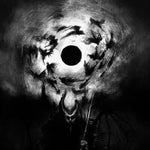
Artwork Credit: Franz von Stuck, Lucifer, c. 1890. Etching and drypoint on paper with chine collé. Rijksmuseum, Amsterdam, object no. RP-P-1948-174. Public Domain.
Persistent museum record: Rijksmuseum – Lucifer by Franz von Stuck
Lucifer
Among Stuck's most unforgettable images is Lucifer, a subject he developed around 1890 in both painted and printed versions.
There is almost no action.
Lucifer simply sits.
His body disappears into darkness while his face and enormous eyes remain fixed on the viewer. Rather than presenting the Devil as a horned monster surrounded by flames, Stuck gives him a disturbingly human presence.
He appears intelligent, resentful, watchful—and patient.
The restraint is what gives the image its power. Lucifer does not need to attack. The threat exists entirely in his gaze.
A surviving Stuck print of Lucifer, dating to around 1890, was produced using etching and drypoint. The Rijksmuseum identifies the figure simply as a "human-shaped devil," while the British Museum notes that Stuck also created closely related painted versions of the subject.
More than a century later, it remains one of the great demonic images of Symbolist art.

The Sin (1893), by Franz von Stuck, Neue Pinakothek, Munich.
The Sin
If Lucifer represents darkness waiting in silence, The Sin (Die Sünde) turns temptation into something seductive.
Stuck created several versions of the composition beginning in the early 1890s. In the celebrated 1893 version, a nearly naked woman emerges from a field of darkness while a massive serpent coils across her body and shoulder.
Only portions of her skin catch the light.
The snake does not appear to be attacking her. The two figures exist together.
That ambiguity is central to the painting.
The woman can be read as Eve, temptation, sexuality, or Sin itself. Rather than illustrating a biblical story literally, Stuck compresses the idea into a single confrontation between the figure and the viewer.
The painting became one of his defining works. The Bayerische Staatsgemäldesammlungen notes that versions of the subject were created between 1891 and 1912 and that the image made an enormous impression on contemporary audiences.
Stuck had found a visual language he would revisit throughout his career: beauty made threatening, desire intertwined with danger.

Franz von Stuck (1863 - 1928) Franz von Stuck (1863–1928). Source: Internet Archive, Franz von Stuck image collection. Source

Franz von Stuck (1863 - 1928) Franz von Stuck (1863–1928). Source: Internet Archive, Franz von Stuck image collection. Source
Medusa
The same tension appears in Stuck's Medusa of 1892.
Medusa had already fascinated generations of artists, but she was especially suited to the imagination of the Symbolists. She could represent beauty and horror simultaneously—a figure desired and feared in equal measure.
Stuck places almost everything in her expression.
Her eyes stare outward. Her lips part slightly. Snakes surround her head, but the painting avoids the exaggerated monster imagery often associated with the myth.
Instead, there is a strange uncertainty.
Is Medusa threatening us, frightened herself, or already witnessing her own death?
The Germanisches Nationalmuseum describes precisely this ambiguity as one of the image's most disturbing qualities. Stuck transforms a familiar mythological monster into something psychological.
As with Lucifer, the horror lies in the stare.

Franz von Stuck (1863–1928), Wild Hunt (1899), oil, dimensions not known, Musée d’Orsay, Paris. Wikimedia Commons.
Inferno, War, and the Mythological World
Stuck's darker imagination extended well beyond individual portraits.
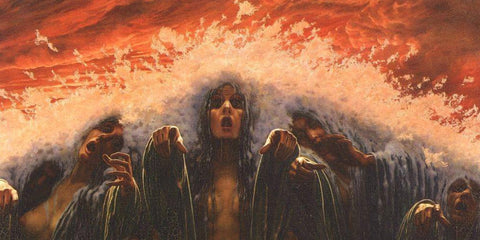
In paintings such as Inferno and War, bodies collide in scenes of violence, punishment, panic, and desire. His 1894 painting War presents the subject on a monumental scale, while Inferno turns damnation into a mass of distorted bodies, serpents, fire, and terror.
Even Stuck's centaurs and other mythological subjects often feel less like illustrations of antiquity than eruptions of something primitive.
Civilization disappears.
Instinct takes over.
That mixture of classical mythology and psychological darkness places Stuck firmly within the strange world of late nineteenth-century Symbolism, when artists increasingly turned away from straightforward realism in search of dreams, nightmares, sexuality, spiritualism, mythology, and the unconscious.

Salome, 1906 Public Domain
File:Stuck, Franz von - Salome - Google Art Project.jpg
Created: 1906

Franz von Stuck (1863 - 1928) Franz von Stuck (1863–1928). Source: Internet Archive, Franz von Stuck image collection. Source
Beauty With Something Wrong Beneath It
Perhaps the most compelling quality in Franz von Stuck's work is that it rarely announces itself as horror.
His figures are beautifully painted. Bodies are idealized. Compositions can be elegant and controlled. His decorative frames and presentation often gave paintings the presence of precious objects or religious icons.
Then you look closer. A serpent appears. A smile becomes threatening. A pair of eyes refuses to release you. The beautiful surface begins to feel dangerous.
This tension between attraction and unease is what makes Stuck's work so powerful—and why it continues to resonate with audiences drawn to dark art more than a century later.

Franz von Stuck (1863–1928), The Kiss of the Sphinx (1895), oil on canvas, 160 x 144.8 cm, Szépművészeti Múzeum, Budapest, Hungary. Wikimedia Commons.

Franz von Stuck (1863 - 1928) Franz von Stuck (1863–1928). Source: Internet Archive, Franz von Stuck image collection. Source

Franz von Stuck (1863 - 1928) Franz von Stuck (1863–1928). Source: Internet Archive, Franz von Stuck image collection. Source
Franz von Stuck at Dark Art & Craft
Dark Art & Craft is beginning to explore the work of Franz von Stuck (1863–1928) through a selection of restored and color-corrected archival reproductions.
The collection focuses on the works that best reveal Stuck's darker Symbolist world: Lucifer, sin, mythology, infernal figures, dangerous beauty, and the strange territory where desire and fear meet.
Alongside the stark engravings and black-and-white works of artists such as Aubrey
It also brings something new to the Dark Art & Craft archive. Beardsley, Gustave Doré, and other masters of the macabre, Stuck introduces deep, dramatic Symbolist color—black backgrounds, spectral flesh, poisonous greens, fire-red accents, and figures that seem to glow from within the darkness.
More works will be added as the archive grows.
Explore the Franz von Stuck Collection →
Further Reading & Resources
-
Villa Stuck – Franz von Stuck
Excellent biographical timeline from the museum housed in Stuck’s former Munich residence.
Villa Stuck – Franz von Stuck -
The Metropolitan Museum of Art – Inferno, 1908
Strong background on Stuck’s darker Symbolist imagery, including hell, demons, serpents, and psychological horror.
The Met – Franz von Stuck, Inferno -
Rijksmuseum – Lucifer, c. 1890
Museum record for Stuck’s Lucifer etching and drypoint, including object information and public-domain status.
Rijksmuseum – Franz von Stuck, Lucifer -
The Metropolitan Museum of Art – Franz von Stuck Collection
Useful for exploring additional works by Stuck across painting, printmaking, and sculpture, including his mythological subjects.
Explore Franz von Stuck at The Met